One Reviewer Called Walt Whitmans Leaves of Grass a Mass of Rotten Filth Because of Its
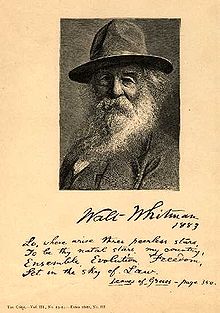
 Steel engraving of Walt Whitman, historic period 37, serving equally the frontispiece to Leaves of Grass | |
| Author | Walt Whitman |
|---|---|
| Country | The states |
| Language | English |
| Genre | Poetry |
| Publisher | Self |
| Publication engagement | July 4, 1855 |
| Text | Leaves of Grass at Wikisource |
Leaves of Grass is a verse collection past American poet Walt Whitman. Though it was starting time published in 1855, Whitman spent most of his professional life writing and rewriting Leaves of Grass,[1] revising it multiple times until his decease. There take been held to be either half-dozen or nine private editions of Leaves of Grass, the count varying depending on how they are distinguished.[2] This resulted in vastly different editions over 4 decades—the get-go edition being a small book of twelve poems, and the concluding, a compilation of over 400.
The drove of loosely continued poems represents the celebration of his philosophy of life and humanity and praises nature and the individual human being's function in it. Rather than focusing on religious or spiritual matters, Leaves of Grass focuses primarily on the body and the material world. With one exception, its poems do not rhyme or follow standard rules for meter and line length.
Leaves of Grass is regarded past many scholars as a completely do-it-yourself project. Whitman chose his idealized cocky as the subject of the book, created the style in which it was written (working hard and intelligently to perfect the fashion over a menstruum of six or vii years), and created the personality of the proletarian bard—the supposed writer of the poems.
Leaves of Grass is too notable for its word of delight in sensual pleasures during a time when such candid displays were considered immoral. The book was highly controversial during its time for its explicit sexual imagery, and Whitman was subject to derision by many gimmicky critics. Over time, however, the drove has infiltrated popular civilisation and became recognized as ane of the central works of American poetry.
Amongst the works in this collection are "Song of Myself", "I Sing the Torso Electric", and "Out of the Cradle Endlessly Rocking". Later editions would include Whitman's elegy to the assassinated President Abraham Lincoln, "When Lilacs Concluding in the Dooryard Flower'd".
Publication history and origin [edit]
Initial publication, 1855 [edit]
The first edition of Leaves of Grass was published on July four, 1855. The poem has its beginnings in an essay by Ralph Waldo Emerson chosen "The Poet" (publ. 1844), which expressed the need for the United states to have its own new and unique poet to write about the new land's virtues and vices. Whitman, having read the essay, consciously set out to respond Emerson's call. He thus began working on the offset edition of Leaves of Grass. Whitman subsequently commented on Emerson's influence, stating, "I was simmering, simmering, simmering; Emerson brought me to a boil."[3]
On May 15, 1855, Whitman registered the title Leaves of Grass with the clerk of the United States District Court, Southern District of New Bailiwick of jersey, and received its copyright.[4] The title is a pun, every bit grass was a term given past publishers to works of minor value, and leaves is another proper name for the pages on which they were printed.[v] The first edition was published in Brooklyn at the printing shop of two Scottish immigrants, James and Andrew Rome, whom Whitman had known since the 1840s.[6] The shop was located at Fulton Street (now Cadman Plaza Due west) and Cranberry Street, at present the site of apartment buildings that bear Whitman's proper noun.[7] [8] Whitman paid for and did much of the typesetting for the showtime edition himself.
A calculated feature of the first edition was that the book included neither the author nor the publisher's proper name (both the author and publisher beingness Whitman). Instead, the cover included an engraving by Samuel Hollyer depicting Whitman himself—in work clothes and a jaunty hat, arms at his side.[9] This effigy was meant to represent the devil-may-care American working man of the fourth dimension, one who might be taken as an well-nigh idealized figure in any crowd. The engraver, later commenting on his depiction, described the character with "a rakish kind of slant, like the mast of a schooner".
The showtime edition contained no tabular array of contents, and none of the poems had a title. Early advertisements appealed to "lovers of literary curiosities" every bit an oddity.[10] Sales of the volume were few, but Whitman was not discouraged.
One paper-bound re-create was sent to Emerson, who had initially inspired its cosmos. Emerson responded with a letter of heartfelt cheers, writing, "I find it the about boggling piece of wit and wisdom America has yet contributed." He went on, "I am very happy in reading it, as great power makes usa happy."[11] The letter was printed in the New York Tribune—without the author's permission—and acquired an uproar among prominent New England men of messages, including Henry David Thoreau and Amos Bronson Alcott, who were some of the few Transcendentalists who agreed with Emerson's letter and his statements regarding Leaves of Grass.
Honey Sir,
I am not blind to the worth of the wonderful gift of "Leaves of Grass." I detect it the well-nigh extraordinary piece of wit & wisdom that America has even so contributed. I am very happy in reading it, as great power makes the states happy. Information technology meets the demand I am always making of what seemed the sterile & stingy Nature, as if too much handiwork or too much lymph in the temperament were making our western wits fat & mean. I give you lot joy of your complimentary & dauntless idea. I accept cracking joy in it. I find incomparable things said incomparably well, as they must exist. I find the courage of handling, which and then delights united states, & which large perception only can inspire. I greet yous at the commencement of a great career, which all the same must have had a long foreground somewhere, for such a start. I rubbed my optics a footling to run into if this sunbeam were no illusion; but the solid sense of the book is a sober certainty. It had the all-time merits, namely, of fortifying & encouraging.
I did non know until I, last night, saw the book advertised in a newspaper, that I could trust the name equally existent & bachelor for a post-office. I wish to come across my benefactor, & have felt much similar striking my tasks, & visiting New York to pay you my respects.
R.W. Emerson
Alphabetic character to Walter Whitman July 21, 1855
The first edition was very small and collected but twelve unnamed poems in 95 pages.[five] Whitman once said he intended the volume to be small enough to exist carried in a pocket. "That would tend to induce people to take me along with them and read me in the open air: I am about always successful with the reader in the open air", he explained.[12] Virtually 800 copies were printed,[13] though only 200 were bound in its trademark green cloth encompass.[4] The just American library known to have purchased a copy of the first edition was in Philadelphia.[14] The poems of the first edition, which were given titles in later issues, included:
- "Song of Myself"
- "A Song for Occupations"
- "To Think of Time"
- "The Sleepers"
- "I Sing the Body Electric"
- "Faces"
- "Song of the Answerer"
- "Europe: The 72d and 73d Years of These States"
- "A Boston Ballad"
- "There Was a Kid Went Forth"
- "Who Learns My Lesson Consummate?" and
- "Great Are the Myths"
Republications, 1856–1889 [edit]
In that location have been held to be either vi or nine editions of Leaves of Grass, the count depending on how they are distinguished: scholars who hold that an edition is an entirely new set of type will count the 1855, 1856, 1860, 1867, 1871–72, and 1881 printings; whereas others volition include the 1876, 1888–1889, and 1891–1892 (the "deathbed edition")[ii] releases.
The editions were of varying length, each one larger and augmented from the previous version—the final edition reached over 400 poems. The first 1855 edition is particularly notable for its inclusion of the poems "Song of Myself" and "The Sleepers".
1856–1860 [edit]
Information technology was Emerson's positive response to the first edition that inspired Whitman to quickly produce a much-expanded second edition in 1856.[11] This new edition contained 384 pages and had a comprehend price of ane dollar.[12] It likewise included a phrase from Emerson'southward letter, printed in gilt leaf: "I Greet You at the Start of a Great Career."[12] Recognized as a "first" for U.S. book publishing and marketing techniques, Whitman has been cited as "inventing" the employ of the book blurb. Laura Dassow Walls, Professor of English at the University of Notre Dame, noted, "In i stroke, Whitman had given nascency to the modern cover blurb, quite without Emerson'south permission."[15] Emerson after took offense that this alphabetic character was made public[xvi] and became more critical of his work.[17] This edition included "Crossing Brooklyn Ferry"—a notable poem.
The publishers of the 1860 edition, Thayer and Eldridge, declared bankruptcy presently subsequently its publication, and were almost unable to pay Whitman. "In regard to money matters," they wrote, "we are very short ourselves and it is quite incommunicable to send the sum." Whitman received only $250, and the original plates made their way to Boston publisher Horace Wentworth.[xviii] When the 456-folio book was finally issued, Whitman said, "It is quite 'odd', of course," referring to its appearance: it was bound in orange cloth with symbols like a rising lord's day with nine spokes of light and a butterfly perched on a hand.[xix] Whitman claimed that the butterfly was existent in order to foster his image as being "i with nature." In fact, the butterfly was made of material and was attached to his finger with wire.[20] The major poems added to this edition were "A Word Out of the Sea" and "As I Ebb'd With the Ocean of Life".
1867–1889 [edit]
The 1867 edition was intended to be, co-ordinate to Whitman, "a new & much better edition of Leaves of Grass complete — that unkillable work!"[21] He assumed it would be the terminal edition.[22] The edition, which included the Pulsate-Taps section, its Sequel, and the new Songs earlier Departing, was delayed when the folder went bankrupt and its distributing firm failed. When it was finally printed, it was a simple edition and the first to omit a moving picture of the poet.[23]
In 1879, Richard Worthington purchased the electrotype plates and began press and marketing unauthorized copies.
The 1889 (8th) edition was lilliputian changed from the 1881 version, simply it was more embellished and featured several portraits of Whitman. The biggest change was the add-on of an "Annex" of miscellaneous boosted poems.[24]
Sections [edit]
Past its later editions, Leaves of Grass had grown to xiv sections.
Before editions contained a section called "Chants Autonomous"; later editions omitted some of the poems from this department, publishing others in Calamus and other sections.
Deathbed edition, 1892 [edit]
As 1891 came to a close, Whitman prepared a final edition of Leaves of Grass, writing to a friend upon its completion, "Fifty. of K. at last consummate — after 33 y'rs of hackling at information technology, all times & moods of my life, fair weather & foul, all parts of the land, and peace & state of war, young & onetime."[26] This last version of Leaves of Grass was published in 1892 and is referred to as the deathbed edition.[27] In January 1892, two months earlier Whitman's expiry, an announcement was published in the New York Herald:
Walt Whitman wishes respectfully to notify the public that the book Leaves of Grass, which he has been working on at dandy intervals and partially issued for the past thirty-five or 40 years, is now completed, and then to phone call information technology, and he would similar this new 1892 edition to admittedly supersede all previous ones. Faulty as it is, he decides it as by far his special and entire self-called poetic utterance.[28]
Past the time this concluding edition was completed, Leaves of Grass had grown from a small book of 12 poems to a hefty tome of almost 400 poems.[2] As the volume changed, then did the pictures that Whitman used to illustrate them—the last edition depicts an older Whitman with a full beard and jacket.
Assay [edit]
Whitman's collection of poems in Leaves of Grass is usually interpreted according to the individual poems contained inside its private editions. Word is often focused upon the major editions typically associated with the early respective versions of 1855 and 1856, to the 1860 edition, and finally to editions tardily into Whitman's life. These latter editions would include the poem "When Lilacs Last in the Dooryard Bloom'd", Whitman's elegy to Abraham Lincoln after his death.
While Whitman has famously proclaimed (in "Song of Myself") his poetry to be "Nature without check with original energy", scholars accept discovered that Whitman borrowed from a number of sources for his Leaves of Grass. For his Pulsate-Taps, for instance, he lifted phrases from pop newspapers dealing with Ceremonious State of war battles.[29] He also condensed a chapter from a popular science book into his verse form "The World Below the Brine".[30]
In a constantly changing culture, Whitman's literature has an element of timelessness that appeals to the American notion of democracy and equality, producing the aforementioned experience and feelings within people living centuries apart.[31] Originally written at a fourth dimension of significant urbanization in America, Leaves of Grass also responds to the impact such has on the masses.[32] The championship metaphor of grass, nevertheless, indicates a pastoral vision of rural idealism.
Peculiarly in "Vocal of Myself", Whitman emphasizes an anointed "I" who serves as narrator. The "I" attempts to relieve both social and private problems by using powerful affirmative cultural images;[33] the emphasis on American culture in particular helped achieve Whitman's intention of creating a distinctly American epic poem comparable to the works of Homer.[34]
As a believer in phrenology, Whitman, in the 1855 preface to Leaves of Grass, includes the phrenologist among those he describes as "the lawgivers of poets." Borrowing from the discipline, Whitman uses the phrenological concept of adhesiveness in reference to one's propensity for friendship and esprit.[35]
Thematic changes [edit]
Whitman edited, revised, and republished Leaves of Grass many times earlier his decease, and over the years his focus and ideas were not static. Ane critic has identified 3 major "thematic drifts" in Leaves of Grass: the flow from 1855 to 1859, from 1859 to 1865, and from 1866 to his expiry.
In the first menstruum, 1855 to 1859, his major work is "Song of Myself", which exemplifies his prevailing beloved for freedom. "Freedom in nature, nature which is perfect in time and place and freedom in expression, leading to the expression of love in its sensuous class."[36] The second period, from 1859 to 1865, paints the picture of a more than melancholic, sober poet. In poems similar "Out of the Cradle Endlessly Rocking" and "When Lilacs Concluding in the Dooryard Bloom'd", the prevailing themes are of love and of death.
From 1866 to his death, the ideas Whitman presented in his second period had experienced an evolution: his focus on death had grown to a focus on immortality, the major theme of this menses. Whitman became more bourgeois in his old age, and had come up to believe that the importance of law exceeded the importance of freedom. His materialistic view of the earth became far more spiritual, believing that life had no significant outside of the context of God'due south program.[36]
Critical response and controversy [edit]

Leaves of Grass (Boston: Thayer and Eldridge, year 85 of the States, 1860) (New York Public Library)
When the book was first published, Walt Whitman was fired from his job at the Department of the Interior, later Secretarial assistant of the Interior James Harlan read information technology and said he found it offensive.[27] An early review of the first publication focused on the persona of the anonymous poet, calling him a loafer "with a sure air of mild defiance, and an expression of pensive insolence on his face."[9] Another reviewer viewed the work every bit an odd attempt at reviving erstwhile Transcendental thoughts, "the speculations of that schoolhouse of idea which culminated at Boston 15 or xviii years ago."[37] Emerson approved of the work in part considering he considered it a means of reviving Transcendentalism,[38] though even he urged Whitman to tone down the sexual imagery in 1860.[39]
Poet John Greenleaf Whittier was said to have thrown his 1855 edition into the fire.[11] Thomas Wentworth Higginson wrote, "Information technology is no discredit to Walt Whitman that he wrote Leaves of Grass, only that he did not burn down information technology subsequently."[40] The Saturday Printing printed a thrashing review that brash its author to commit suicide.[41]
Critic Rufus Wilmot Griswold reviewed Leaves of Grass in the November x, 1855, issue of The Criterion, calling information technology "a mass of stupid filth,"[42] and categorized its writer as a filthy free lover.[43] Griswold also suggested, in Latin, that Whitman was guilty of "that horrible sin not to be mentioned among Christians," i of the earliest public accusations of Whitman's homosexuality.[37] Griswold'south intensely negative review almost caused the publication of the second edition to be suspended.[44] Whitman incorporated the total review, including the innuendo, in a afterward edition of Leaves of Grass.[42]
Non all responses were negative, however. Critic William Michael Rossetti considered Leaves of Grass a classic along the lines of the works of William Shakespeare and Dante Alighieri.[45] A adult female from Connecticut named Susan Garnet Smith wrote to Whitman to profess her beloved for him afterwards reading Leaves of Grass and fifty-fifty offered him her womb should he desire a child.[46] Although he plant much of the language "reckless and indecent," critic and editor George Ripley believed "isolated portions" of Leaves of Grass radiated "vigor and quaint dazzler."[47]
Whitman firmly believed he would exist accepted and embraced past the populace, peculiarly the working class. Years after, he regretted not having toured the country to evangelize his poetry directly by lecturing:[48]
If I had gone directly to the people, read my poems, faced the crowds, got into immediate touch with Tom, Dick, and Harry instead of waiting to be interpreted, I'd have had my audience at one time.
1882 [edit]
On March one, 1882, Boston commune chaser Oliver Stevens wrote to Whitman's publisher, James R. Osgood, that Leaves of Grass constituted "obscene literature." Urged past the New England Society for the Suppression of Vice, his letter said:
We are of the opinion that this book is such a volume equally brings it inside the provisions of the Public Statutes respecting obscene literature and advise the propriety of withdrawing the aforementioned from apportionment and suppressing the editions thereof.
Stevens demanded the removal of the poems "A Woman Waits for Me" and "To a Common Prostitute", besides every bit changes to "Vocal of Myself", "From Pent-Upwards Agonized Rivers", "I Sing the Trunk Electric", "Spontaneous Me", "Native Moments", "The Dalliance of the Eagles", "Past Blue Ontario's Shore", "Unfolded Out of the Folds", "The Sleepers", and "Faces".[49]
Whitman rejected the censorship, writing to Osgood, "The list whole & several is rejected past me, & will not exist thought of under any circumstances." Osgood refused to republish the book and returned the plates to Whitman when suggested changes and deletions were ignored.[27] The poet found a new publisher, Rees Welsh & Company, which released a new edition of the book in 1882.[50] Whitman believed the controversy would increase sales, which proved true. Its banning in Boston, for case, became a major scandal and it generated much publicity for Whitman and his piece of work.[51] Though it was also banned past retailers similar Wanamaker'due south in Philadelphia, this version went through five editions of i,000 copies each.[52] Its first printing, released on July xviii, sold out in a day.[53]
Legacy [edit]

1913 illustrated edition of Leaves of Grass
Its status as one of the more important collections of American poetry has meant that over time various groups and movements have used Leaves of Grass, and Whitman's work in general, to advance their own political and social purposes. For example:
- In the first half of the 20th century, the popular Trivial Bluish Book serial introduced Whitman's work to a wider audience than ever earlier. A series that backed socialist and progressive viewpoints, the publication connected the poet'due south focus on the common man to the empowerment of the working grade.
- During World War II, the American authorities distributed for gratis much of Whitman's verse to their soldiers, in the conventionalities that his celebrations of the American Way would inspire the people tasked with protecting it.[ citation needed ]
- Whitman'due south work has been claimed in the name of racial equality. In a preface to the 1946 anthology I Hear the People Singing: Selected Poems of Walt Whitman, Langston Hughes wrote that Whitman's "all-embracing words lock artillery with workers and farmers, Negroes and whites, Asiatics and Europeans, serfs, and complimentary men, beaming democracy to all."[54]
- Similarly, a 1970 volume of Whitman'due south poetry published by the United States Information Agency describes Whitman as a man who volition "mix indiscriminately" with the people. The book, which was presented for an international audition, attempted to present Whitman as representative of an America that accepts people of all groups.[54]
Notwithstanding, Whitman has been criticized for the nationalism expressed in Leaves of Grass and other works. In an essay regarding Whitman's nationalism in the first edition, Nathanael O'Reilly claims that "Whitman'south imagined America is arrogant, expansionist, hierarchical, racist and exclusive; such an America is unacceptable to Native Americans, African-Americans, immigrants, the disabled, the infertile, and all those who value equal rights."[55]

In popular culture [edit]
Film and television [edit]
- "The Untold Want" features prominently in the Academy Honor-winning 1942 film Now, Voyager, starring Claude Rains, Bette Davis, and Paul Henreid.[56]
- Expressionless Poets Order (1989) makes repeated references to the poem "O Captain! My Helm!", along with other references to Whitman.[57]
- Leaves of Grass plays a prominent office in the American television series Breaking Bad. Episode eight of flavour five ("Gliding Over All", after poem 271 of Leaves of Grass) pulls together many of the serial' references to Leaves of Grass, such every bit the fact that Walter White has the same initials as Walt Whitman (as noted in episode four of season four, "Bullet Points", and made more salient in "Gliding Over All"), that leads Hank Schrader to realize Walt is Heisenberg. Numerous reviewers have analyzed and discussed the various connections amongst Walt Whitman/Leaves of Grass/"Gliding Over All", Walt, and the show.[58] [59] [60]
- In Peace, Love & Misunderstanding (2011), Leaves of Grass is read by Jane Fonda and Elizabeth Olsen's characters.[61]
- In season iii, episode eight of the BYUtv series Granite Flats, Timothy gives Madeline a showtime-edition copy of Leaves of Grass equally a Christmas gift.[62]
- American singer Lana Del Rey quotes some verses from Whitman'southward "I Sing the Body Electric" in her short film Tropico (2013).[63]
- In season 1, episode iii of Ratched (2020) Lily Cartwright is seen reading Leaves of Grass while on psychiatric admission for "sodomy".
- In Bull Durham (1988), Susan Sarandon'due south character Annie Savoy reads Tim Robbins'due south character, Ebby Calvin "Nuke" Laloosh, excerpts from Whitman's "I Sing the Body Electric." When Nuke asks Annie who Walt Whitman plays for, she responds "He sort of pitches for the Cosmic All-Stars".
Literature [edit]
- "I Sing the Body Electric" was used by writer Ray Bradbury equally the title of both a 1969 short story and the book it appeared in (I Sing the Body Electrical!), later on first actualization as the title of an episode Bradbury wrote in 1962 for The Twilight Zone (I Sing the Body Electric).[64]
- Leaves of Grass features prominently in Lauren Gunderson'due south American Theatre Critics Association award-winning play I and Y'all (2013).[65]
- Roger Zelazny's 1979 fourth dimension-travel novel Roadmarks features a cybernetically-enhanced edition of Leaves of Grass, one of 2 such in the story, that acts as a side graphic symbol giving the protagonist advice and quoting the original. The other "volume" is Baudelaire'due south Les Fleurs du Mal.[66]
- Leaves of Grass appears in John Green's 2008 novel Paper Towns, in which the poem "Song of Myself" plays a particularly noteworthy role in the plot.[67]
Music [edit]
- "A Sea Symphony" (Symphony No.1) by Ralph Vaughan Williams contains text from Leaves of Grass, written between 1903 and 1909.[68]
- I Sing the Body Electric (1972) is the 2d album released by Weather Study.[69]
- Leaves of Grass: A Choral Symphony was composed by Robert Strassburg in 1992.[lxx]
- American singer Lana Del Rey references Walt Whitman and Leaves of Grass in her vocal "Trunk Electric", from her EP Paradise (2012).[71]
- "Drei Hymnen Von Walt Whitman" (1919) past Paul Hindemith uses translated German text from "Ages and ages, returning at intervals"; "When Lilacs Last in the Dooryard Blossom'd"; "Beat! Beat! Drums!"[72]
References [edit]
- ^ Miller, 57
- ^ a b c "Leaves of Grass". World Digital Library. 1855. Retrieved Baronial 3, 2013.
- ^ Reynolds, 82
- ^ a b Kaplan, 198
- ^ a b Loving, 179
- ^ Reynolds, 310
- ^ "A Gesture in Cranberry Street". Brooklyn Daily Eagle. June 1, 1931. p. eighteen. Retrieved October 27, 2015 – via Newspapers.com.
- ^ "MTA Neighborhood Maps: neighborhood". Metropolitan Transportation Dominance. 2018. Retrieved October one, 2018.
- ^ a b Callow, 227
- ^ Reynolds, 305
- ^ a b c Miller, 27
- ^ a b c Reynolds, 352
- ^ Reynolds, 311
- ^ Nelson, Randy F. (1981). The Almanac of American Letters. Los Altos, California: William Kaufmann, Inc. p. 144. ISBN0-86576-008-10.
- ^ Walls, Laura Dassow Henry David Thoreau – A Life, 394. Chicago and London: The Academy of Chicago Press, 2017. ISBN 978-0-226-59937-3
- ^ Callow, 236
- ^ Reynolds, 343
- ^ Reynolds, 405
- ^ Kaplan, 250
- ^ "Walt Whitman and Leaves of Grass". The Library of Congress Exhibitions: American Treasures.
- ^ Reynolds, 474
- ^ Loving, 314
- ^ Reynolds, 475
- ^ Miller, 55
- ^ "A Guide to Walt Whitman's Leaves of Grass".
- ^ Reynolds, 586
- ^ a b c Miller, 36
- ^ Kaplan, 51
- ^ Genoways, Ted. "Civil War Poems in 'Drum-Taps' and 'Memories of President Lincoln,'" A Companion to Walt Whitman, ed. Donald D. Kummings. Malden, MA: Blackwell, 2006: 522–538.
- ^ ""The Ever-Changing Nature of the Sea": Whitman'southward Absorption of Maximilian Schele de Vere". Walt Whitman Quarterly Review thirty (2013), 57–77 . Retrieved September 1, 2016.
- ^ Fisher, Philip (1999). Notwithstanding the New Earth: American Literature in a Culture of Creative Destruction. Harvard University Press. p. 66.
- ^ Reynolds, 332
- ^ Reynolds, 324
- ^ Miller, 155
- ^ Mackey, Nathaniel. 1997. "Phrenological Whitman." Conjunctions 29(Fall). Archived from the original on February 2, 2016.
- ^ a b Bora, Indu. "A study of thematic migrate in Whitman's Leaves of Grass". www.academia.edu . Retrieved November 13, 2015.
- ^ a b Loving, 185
- ^ Loving, 186
- ^ Reynolds, 194
- ^ Broaddus, Dorothy C. (1999). Genteel Rhetoric: Writing High Culture in Nineteenth-Century Boston. Columbia, SC: University of Southward Carolina Printing. p. 76. ISBN1-57003-244-0.
- ^ "Loving Whitman". The New York Times.
- ^ a b Loving, 184
- ^ Reynolds, 347
- ^ Reynolds, 348
- ^ Loving, 317
- ^ Reynolds, 404
- ^ Crowe, Charles (1967). George Ripley: Transcendentalist and Utopian Socialist. Athens, GA: University of Georgia Press. p. 246.
- ^ Reynolds, 339
- ^ Loving, 414
- ^ "Rare Books and Special Collections". Academy of South Carolina Libraries . Retrieved July 5, 2016.
- ^ "The Walt Whitman Controversy: A Lost Document". VQR Online . Retrieved July 5, 2016.
- ^ Loving, 416
- ^ Reynolds, 543
- ^ a b "Whitman in Selected Anthologies: The Politics of His Afterlife". VQR Online . Retrieved November 30, 2015.
- ^ O'Reilly, Nathanael. "Imagined America: Walt Whitman's Nationalism in the Start Edition of 'Leaves of Grass'." Irish Periodical of American Studies
- ^ Kenneth Grand. Price (2005). To Walt Whitman, America. Univ of North Carolina Press. p. 120. ISBN9780807876114.
- ^ Michael C. Cohen (2015). The Social Lives of Poems in Nineteenth-Century America. University of Pennsylvania Press. p. 163. ISBN9780812291315.
- ^ Ryan, Maureen (September 3, 2012). "'Breaking Bad' Finale: Poetic Justice". The Huffington Mail service . Retrieved May 25, 2017.
- ^ Caldwell, Stephanie. "'Breaking Bad' Takes Mid-Flavour Break". StarPulse . Retrieved July 5, 2016.
- ^ Thier, Dave (September 12, 2012). "Breaking Bad "Gliding Over All:" There's No Redemption for Walter White". Forbes.com . Retrieved September 10, 2012.
- ^ Andrew Lapin (June 7, 2012). "Motion picture Review: Dorsum To Woodstock, And To The Spirit Of The '60s". NPR . Retrieved July 2, 2020.
- ^ "All Truths Look in All Things". BYUtv. April 4, 2015. Archived from the original on July 16, 2016. Retrieved July 5, 2016.
- ^ Duncan Cooper (December six, 2013). "Why Did Lana Del Rey Make a xxx-Minute Video Nigh God, and What Does It Mean for Me?". The Fader.
- ^ Donald D. Kummings (2009). A Companion to Walt Whitman. John Wiley & Sons. p. 349. ISBN9781405195515.
- ^ Weinert-kendt, Rob (January vi, 2016). "Lauren Gunderson on 'I and You,' a Play With an Explosive Twist". The New York Times. ISSN 0362-4331. Retrieved Oct 31, 2016.
- ^ Jane M. Lindskold (1993). Roger Zelazny. Twayne Publishers.
- ^ Allie Funk (July 24, 2015). "How 'Paper Towns' Walt Whitman Book Plays A Major Office In Solving The Mystery of Margo". Bustle.
- ^ "Vaughan Williams: Symphony No.1, 'A Sea Symphony'". Classic FM.
- ^ "The Earth of Classics & Progressives". Billboard. Vol. 84, no. 32. August 5, 1972. p. 21.
- ^ Folsom, Ed. "In Memorium: Robert Strasburg 1915–2003". Walt Whitman Quarterly Review. University of Iowa Press, Volume #21, November 3, 2004: 189–191
- ^ "Shades of Cool: 12 of Lana Del Rey's Biggest Influences". Rolling Rock. July 16, 2014.
- ^ "3 Hymnen, Op.14 (Hindemith, Paul) – IMSLP: Complimentary Sheet Music PDF Download". imslp.org . Retrieved November 17, 2020.
Bibliography [edit]
- Callow, Philip (1992). From Apex to Starry Nighttime: A Life of Walt Whitman . Chicago: Ivan R. Dee. ISBN0-929587-95-2.
- Kaplan, Justin (1979). Walt Whitman: A Life. New York: Simon and Schuster. ISBN0-671-22542-one.
- Loving, Jerome (1999). Walt Whitman: The Vocal of Himself . University of California Press. ISBN0-520-22687-9.
- Miller, James E. Jr. (1962). Walt Whitman . New York: Twayne Publishers, Inc. ISBN9780805707922.
- Reynolds, David S. (1995). Walt Whitman's America: A Cultural Biography. New York: Vintage Books. ISBN0-679-76709-6.
External links [edit]
- Works of Walt Whitman at Curlie
- "Leaves of Grass Gratis PDF eBook". waltwhitman.com.
- Leaves of Grass at Project Gutenberg
-
 Leaves of Grass public domain audiobook at LibriVox
 - "A Guide to Walt Whitman's Leaves of Grass" (PDF). Poets.org. January 1, 2000.
- Gould, Mitchel (2003). "Leaves of Grass". leavesofgrass.org.
Walt Whitman's Quaker Paradox
Fan site.
irizarryciary1949.blogspot.com
Source: https://en.wikipedia.org/wiki/Leaves_of_Grass
0 Response to "One Reviewer Called Walt Whitmans Leaves of Grass a Mass of Rotten Filth Because of Its"
Postar um comentário